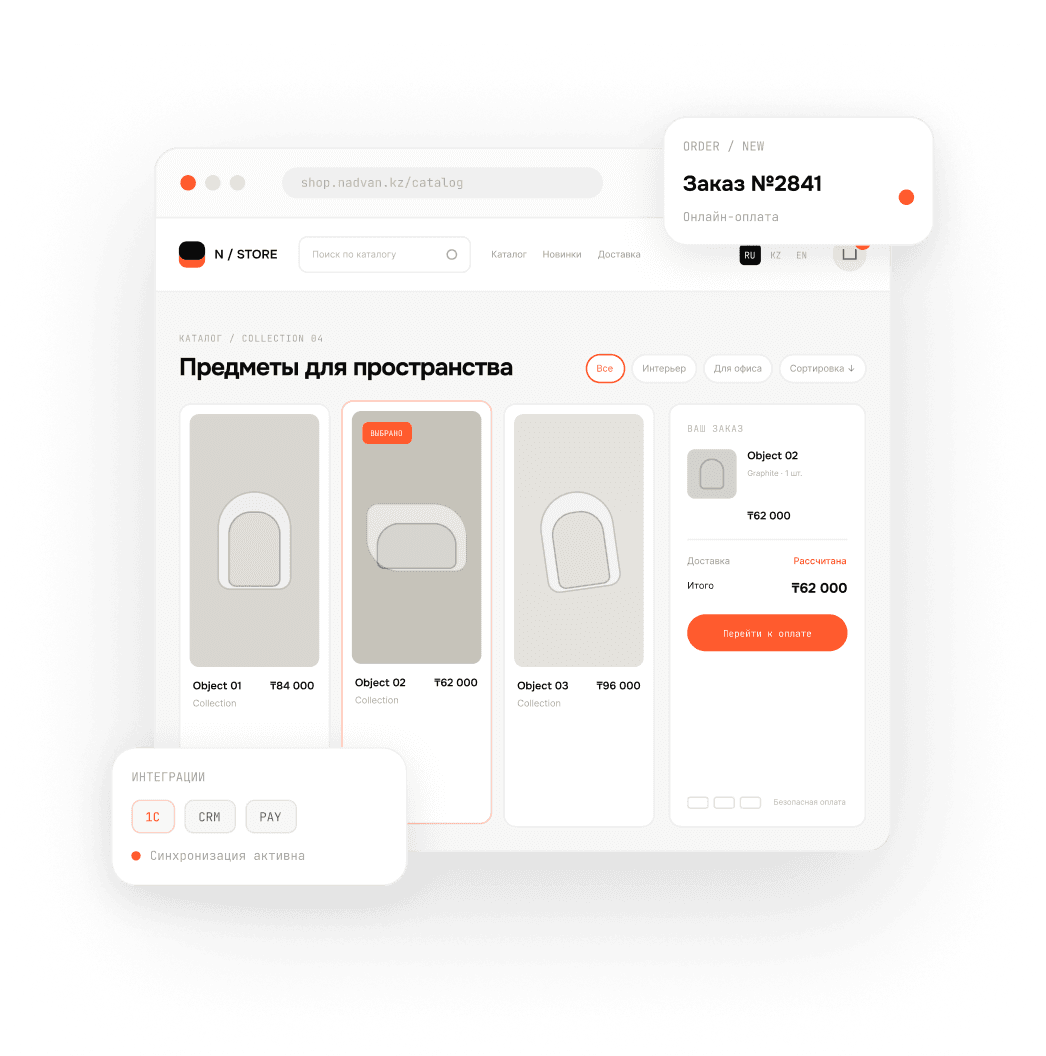
End-to-end online store development: what is included
An end-to-end MedusaJS online store—a headless framework for online stores and marketplaces—includes analysis and catalog structure, UX and brand-based design, catalog development with filters and product pages, cart and checkout, online payments, 1C and CRM integrations, an SEO foundation, testing, and launch. One team handles the work, so tasks are not lost between vendors. Read ‘How we work on a project’ for the process.
Choosing an online store format
- Retail store (B2C): catalog, cart, online payments, and delivery.
- B2B store: wholesale prices, customer-specific terms, and repeat orders.
- Store with physical locations: map of sales locations and showrooms, with inventory by branch.
- Store connected to 1C: products, inventory, prices, and orders without manual entry.
- Catalog with WhatsApp ordering: a quick start without complex payment setup.
- Product rental website: time-based pricing, customer account, and order history.
Online payments, delivery, and checkout
Customers should get from a product page to payment in as few steps as possible. We connect online payments through any payment system that has an API and has been reviewed by a bank (for example, Tiptoppay), SMS sign-in, a simplified mobile checkout form, and shipping calculations. The payment provider, not the store, processes bank card data.
Integrating an online store with 1C and CRM
Products, inventory, prices, orders, and customer data sync with 1C (1C:UNF or 1C:Accounting through a REST API), while orders and customers go to Creatio CRM; we connect other CRMs as needed. Each integration is configured for your processes. Managers do not have to enter orders twice, and website inventory stays in sync with accounting.
Online store SEO: catalog and product pages
Customers find a store by searching for specific products, so SEO starts with the structure: readable category URLs, unique product titles and descriptions, Product and Offer markup, filters without duplicate pages, a sitemap, and load speed. Search promotion and ranking work are separate services.
What affects online store development cost
Online store development starts at KZT 3 million and is usually more expensive than a corporate website because it often requires complex integrations. Cost depends on the number of products, catalog complexity, accounting integrations, payment and delivery methods, custom design, languages, and hosting requirements. Payment options are described in ‘How we estimate cost and choose a payment model’.
A multilingual online store
We build stores in Russian, Kazakh, and English with a language switcher, separate page URLs, and one admin panel. Products and copy are managed in one place, and search engines can show the appropriate version.
Who needs a custom online store
Retail and wholesale companies, manufacturers and distributors, brands with physical stores, and companies that have outgrown a website builder or marketplace.